International Year of the Woman Farmer: Ariel Provencal
Behind the Scenes: Coordinating Logistics and Growth on the Produce Farm
As part of our celebration of the International Year of the Woman Farmer, we’re highlighting the women of Pineland Farms whose work helps shape the experiences visitors enjoy every season. From planting the first seeds in the soil to ensuring the final product ends up in a shopper’s basket, it takes a dedicated team to bring local agriculture to the public.
At the heart of that connection is Ariel, our Assistant Farm Manager in Pineland’s produce division. Balancing a massive daily puzzle of staff coordination, customer logistics, and field management, she plays a vital role in keeping our agriculture operations running smoothly from the initial spring plantings to the bustling autumn harvest.
From Communication Degrees to the Produce Barns
Ariel’s journey to farm management began in an unexpected place. After graduating with a communications degree and a minor in French, she expected her path to lead straight toward a stable, corporate office environment.
“I graduated thinking an office job was the path to a stable career,” she shares. “Then I found a seasonal office position at Pineland that ended just in time for my son to be born. When Justin asked me to come back the following spring, I said, ‘Of course!’—and never left.”
Though she had zero farming or agricultural experience beyond a small childhood backyard garden, Ariel quickly found her footing. Joining the team as a seasonal office assistant in 2015, her dedication and capacity for organization saw her take on more responsibility each year, eventually stepping into the role of Assistant Farm Manager.
“At the farm, there’s always an opportunity to take on something new,” she notes, “whether that’s trying new crops, improving infrastructure, or refining processes.”
Managing the Daily Pulse of a Diverse Operation
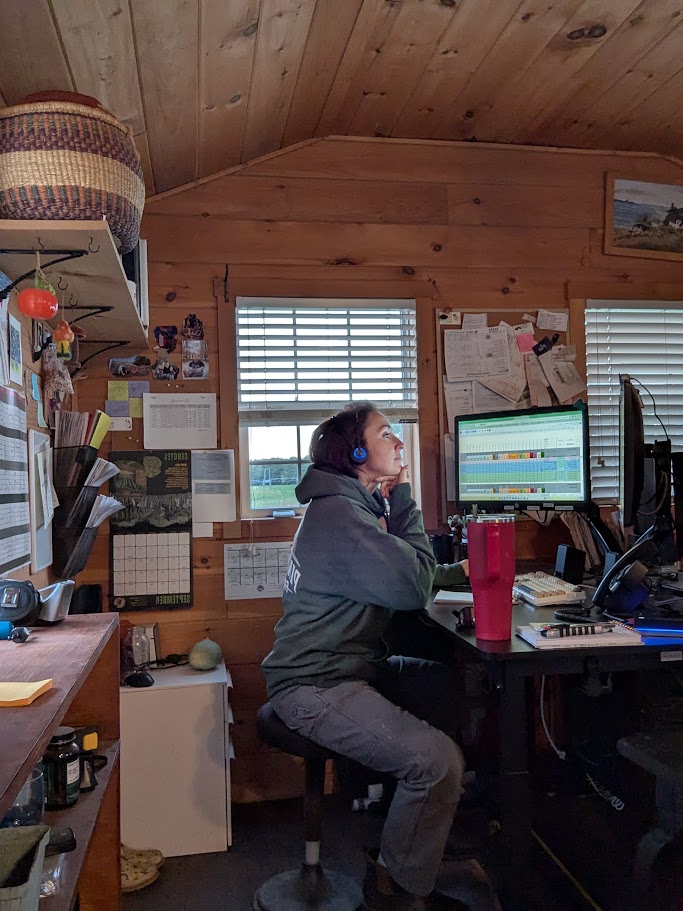
During the peak growing season, a typical day for Ariel is fast-paced and constantly evolving. Her mornings start by adjusting staffing for callouts, answering customer orders, and navigating sudden delivery shifts before heading into the core team meeting.
“Our morning meeting covers everything from what needs to be harvested, packed, shipped, cultivated, planted, or sprayed to which tractors and employees are going where,” Ariel explains.
From there, the workload shifts into overdrive. The team prepares and ships orders, manages inventories, updates pick-your-own information, and handles physical invoices for pickup customers. Most of her job comes down to managing the staff and helping keep the farm running smoothly, but she always prioritizes physical connection with the land.
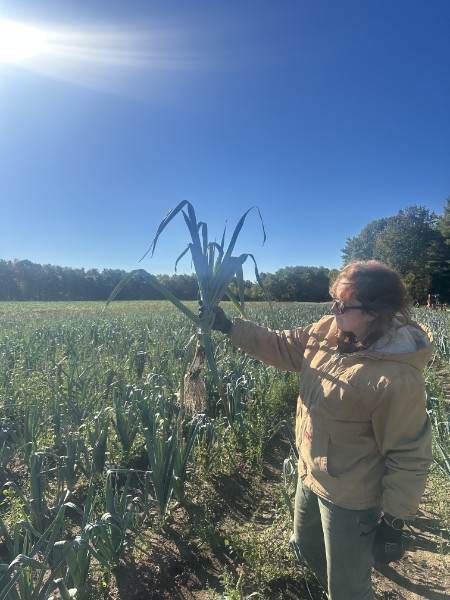
“Throughout the day, I’m coordinating staff, checking in with harvest crews, monitoring field conditions, and troubleshooting whatever comes up,” she says. “When I can get out of the office, I love walking the farm to see how everything is growing and look for problems.”
Predictable Planning Across Unpredictable Elements
Pineland’s produce division grows an extensive variety of crops, requiring meticulous data tracking to balance overlapping timelines. To build a realistic harvest schedule, the management team relies on a mix of field plans, germination charts, and historical patterns.
“We look to the past to plan for the future,” Ariel notes. “We use sales histories, field plans, seeding records, packaging needs, and input from our largest commercial partner, Hannaford, to determine what we should grow and when we expect it to be ready.”
Yet, even the best plans face the realities of outdoor agriculture and tight operational budgets.
“Plants are fascinating and unpredictable. You can repeat the same process from one year to the next and get completely different results, so we’re constantly adjusting,” Ariel explains. “Equipment is another challenge, especially when tight budgets mean relying on older machinery that can break down and change our plans multiple times in a day.”
Through it all, keeping a team motivated remains the true core of her daily strategy.
“For me, people are the most challenging—and most important—part of management. The business couldn’t exist without the people who work for us or buy from us. I want to tell everyone ‘yes,’ but sometimes the business simply doesn’t work that way.”
The Autumn Shift: Pumpkins, Mazes, and Labyrinths
As late summer fades, the produce division undergoes a major structural shift to welcome the fall season. For the management team, transitioning to pumpkins and hard squash brings a welcome change of pace. Because these crops boast a longer shelf life than delicate summer berries, the daily harvest pressure softens, though the physical volume increases dramatically.
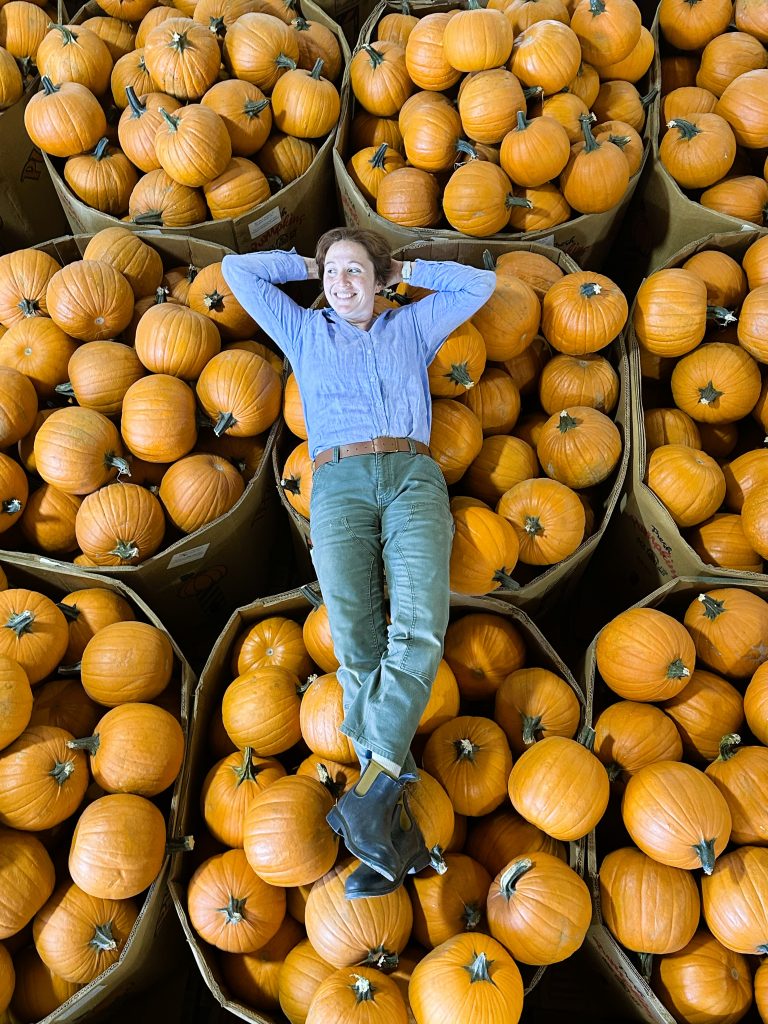
“One of the best things about farming is that just when you start getting bored with one crop, it’s time to shift gears to the next,” Ariel says. “Pumpkins and squash are a very satisfying crop to harvest because we bring them in by the bin and trailer load and fill every nook of the barns with product.”
This marks Pineland’s 12th season growing pumpkins, and the operation has become a highly efficient, preventative process to protect the crops from early Maine frosts.
“We start pumpkins earlier each year, including growing many of the plants in the greenhouse in March and April,” Ariel notes. “Getting pumpkins out of the field early helps reduce the risk of pest damage, mold, mildew, and frost. Jamie Gillespie does a great job organizing the barns and greenhouse so we can bring pumpkins and hard squash in from the cold as early as possible.”
Beyond wholesale distribution, the produce department works hand-in-hand with the Education Department to construct the annual Corn Maze. The produce team sows the specific maze seeds in late June to ensure the stalks are towering and ready for visitors by September. Cathryn Anderson emphasizes the shared vision behind this autumn tradition: “We work year-round to create new ideas for the corn maze while keeping it a highly affordable family experience for everyone in our community.”
Featuring agricultural trivia clues, a dedicated kid-friendly play zone, and the return of the popular Sunflower Labyrinth, the attraction has become a regional staple drawing a massive crowd.
“The maze is part of the whole farm experience,” Ariel shares. “Pineland averages 10,000 visitors at the corn maze and pumpkin patch and this number grows every year. Fall at the farm is a great way for visitors to engage in agriculture and our entire team is behind growing this attraction.”
Connecting the Community to Fresh Food
Getting fresh produce out into the wider region requires an intricate delivery web that moves like clockwork.
“The logistics have been refined over the years, and each season we keep that well-oiled machine running,” Ariel explains. “We call our partners daily to confirm current availability, then coordinate harvesting, packing, and shipping around the next day’s orders.”
Today, the farm supplies roughly 28 regular commercial clients daily, ensuring local neighborhoods have immediate access to fresh food.
“Most are Hannaford partners throughout Southern Maine, where our produce is clearly labeled,” Ariel says. “We also sell to Whole Foods, Native Maine, and several smaller farms that use our produce to fill out their stands.”
Beyond wholesale grocery store shelves, the community can access this fresh harvest right at the source through multiple direct-to-consumer avenues.
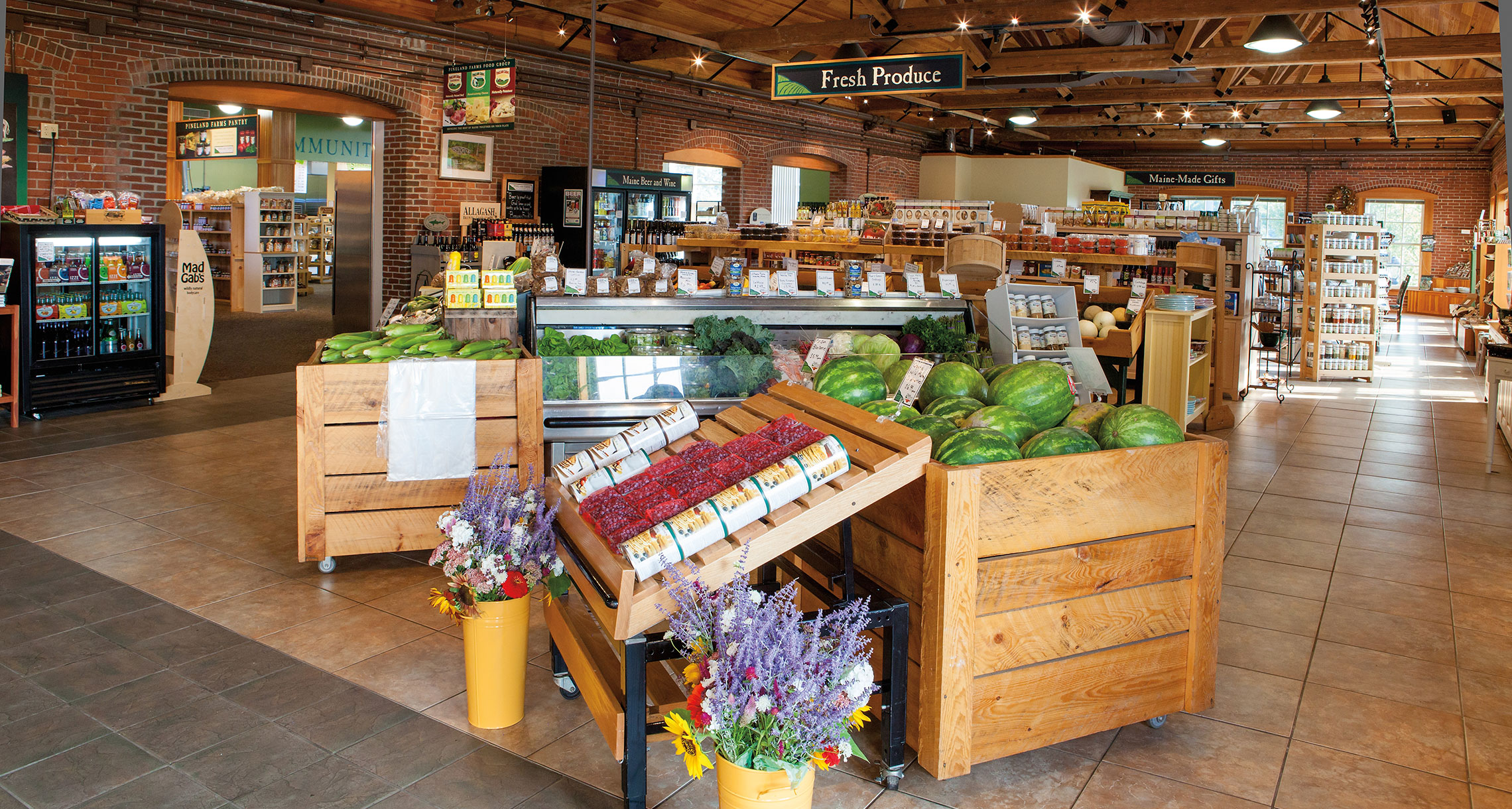
“We also sell to several ‘door sale’ customers who come directly to the farm for some of the freshest produce available—especially during strawberry season,” she notes. Local families can also purchase the farm’s signature pumpkins directly on campus at the Pineland Market.
For Ariel, knowing that this food goes directly to local families brings the work full circle.
“It’s incredibly fulfilling to know our hard work provides food for our neighbors—food I can be proud to see them enjoy,” she reflects. “I thought cooking might be my future for a while because I love feeding people good food, and I guess I ended up doing that in a more roundabout way.”
Seeing the Scale of Agriculture
Ariel notes that the public-facing elements of the farm provide a valuable educational window for the community, helping visitors appreciate the sheer effort behind local food production.
“I love that we offer PYO because it gives people a chance to pick their own food and see what goes into growing it,” she says. “It’s satisfying to see them experience the scale of production happening here, tucked alongside 95 in New Gloucester.”
By stepping into the fields, consumers get a firsthand look at the working parts of a commercial farm.
“They can see the irrigation running, tractors working the fields, and the large harvest crews we hire from the community—all working to get food from our fields to grocery stores just down the road,” she explains.
Women in Agriculture
Reflecting on her journey for the International Year of the Woman Farmer, Ariel underscores that rising into agricultural leadership requires a profound sense of determination, grit, and strong personal support systems.
“It’s not a small feat to rise into this role,” she honors. “There aren’t many women leading in commercial agriculture, and the few I’ve gotten to know are some of the most impressive women I’ve ever met. I’m very proud of the work I do and the farm I’m part of. Taking on this role has required some personal sacrifice, and my family has been incredibly supportive.”
For the next generation of women or young people looking to build a career in farming and agricultural production, her advice is rooted in hands-on exploration and overcoming the fear of failure:
“Try anything and everything.”
“Don’t be afraid to mess it up—that’s often how you learn the most,” Ariel advises. “It’s advice I still have to give myself every day, but it’s the best way to discover what you’re capable of. Farming isn’t for the faint of heart, but it will feed your soul like nothing else.”
A Lasting Impact
Looking back on her decade with the produce division, Ariel’s proudest and most enduring memories are grounded in the powerful sense of community and family that defines the farm.
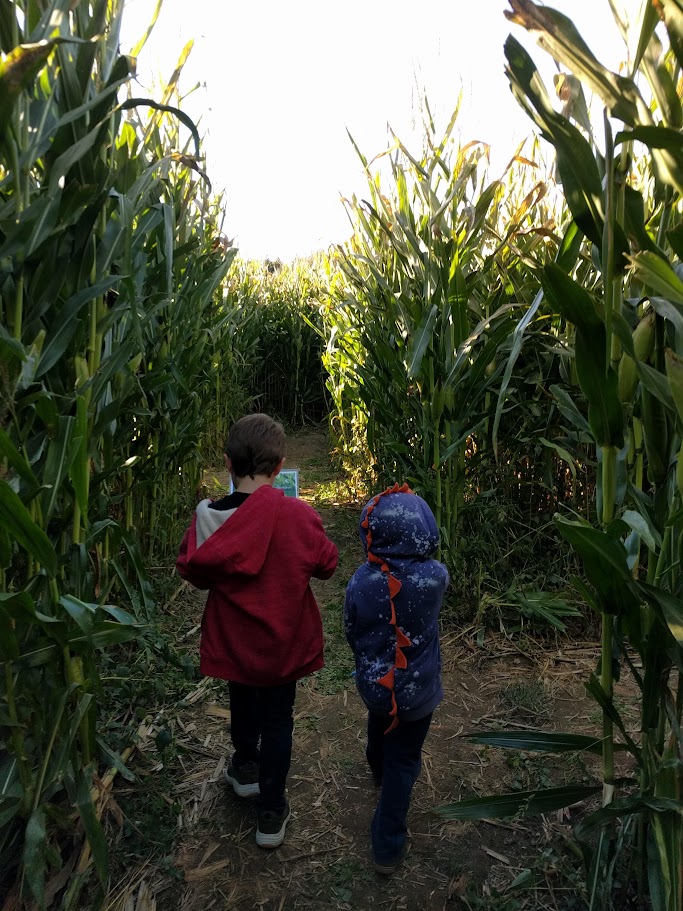
“My favorite memories are simply being in the fields with my kids—bringing them to ‘Mom’s’ work, harvesting the season’s offerings, and introducing them to my wonderful coworkers,” she shares. “Being able to share the farm with my children and family has been pretty awesome, and I hope to share even more of it with them as they grow.”
That same deep connection extends directly to the tight-knit crew she relies on every single day, especially when unexpected agricultural emergencies hit the fields.
“A close second is watching everyone at the farm come together to solve an emergency, whether it’s an unexpected strawberry oversale that has everyone harvesting at 6 p.m. or putting out a baler fire during a drought,” Ariel recalls. “The people are what have made Pineland such a great place to work. A few of us keep track of the priorities, but everyone looks out for and supports one another. That teamwork is what helps the farm thrive.”