International Year of the Woman Farmer: Brittany Moon
Behind the Scenes: Teaching the Next Generation
As part of our celebration of the International Year of the Woman Farmer, we’re highlighting the women of Pineland Farms whose work helps shape the experiences visitors enjoy every season. From introducing children to their first farm animal to sharing the story of where milk comes from, the Education Department at Pineland Farms brings agriculture to life for thousands of visitors each year.
At the heart of that work is Brittany Moon, Assistant Director of the Education Department. With more than a decade at Pineland Farms and a lifelong connection to dairy farming, she has made it her mission to bridge the gap between the farm and the public — one curious visitor at a time.
A Family Tradition on the Farm
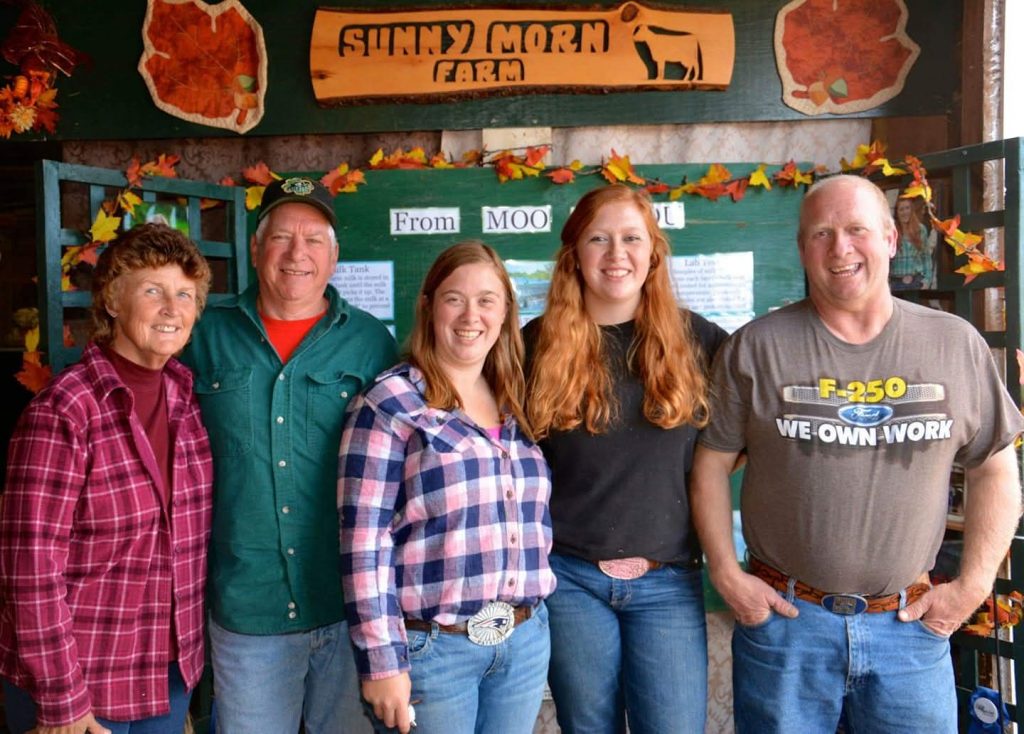
Agriculture isn’t just a career for Brittany — it’s a family legacy. She grew up on a small dairy farm in Freeport, Maine, where her family raised Jersey and Holstein cattle. Her grandparents on her father’s side founded Sunny Morn Farm in 1972, starting with Jersey cows and milking into the early 1990s. Her grandfather on her mother’s side spent much of his life managing a Holstein dairy farm, passing his love of the breed on to her mother, who showed Holsteins in 4-H.
“My parents both favored the Holstein cow,” she says, “but over the years my love for Jersey cows grew and if I had to choose, those little brown Jerseys would be my favorite.”
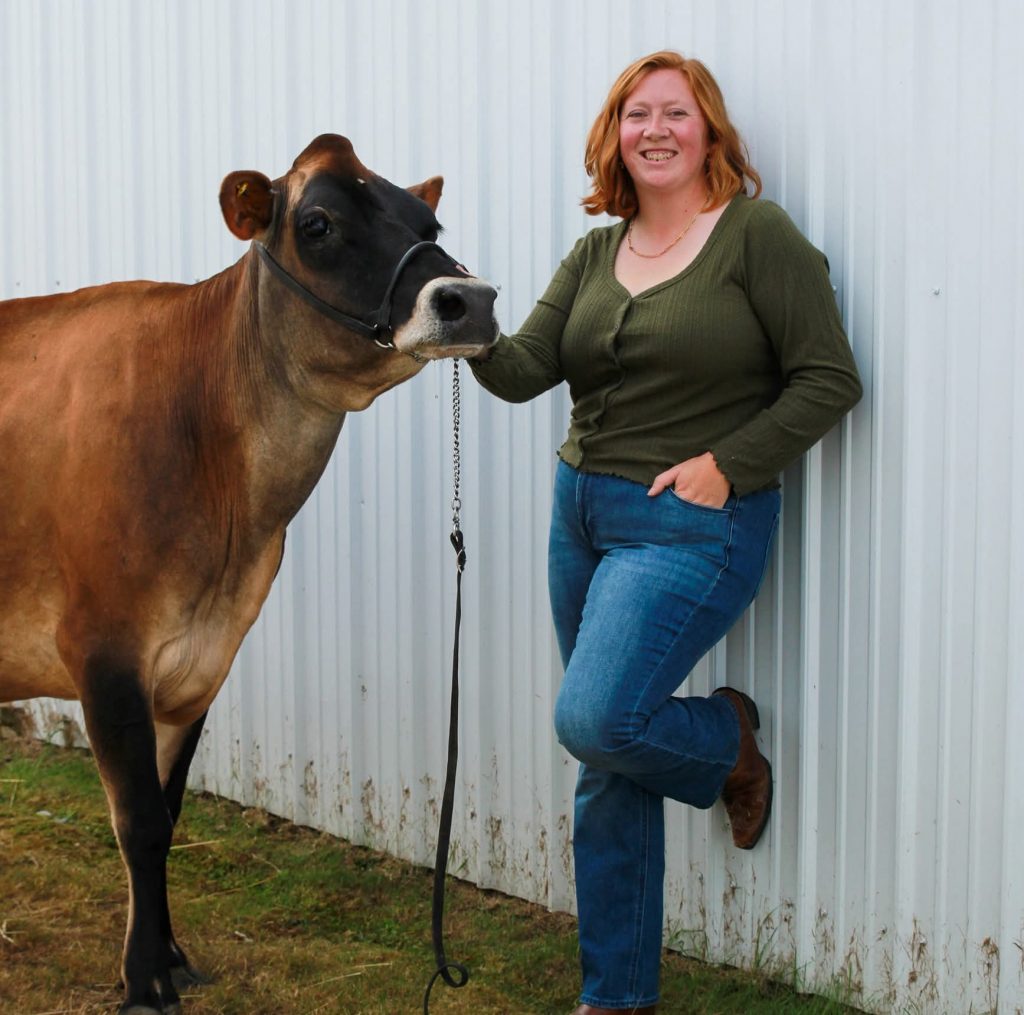
That love runs deep. The Jersey cows she keeps at home today are direct descendants from one of the original cows her grandparents started the family farm with. Her all-time favorite was a Jersey named Saphira, who lived to be 12 years old. Saphira’s granddaughter, Skittles, is now 8 and lives with her at home.
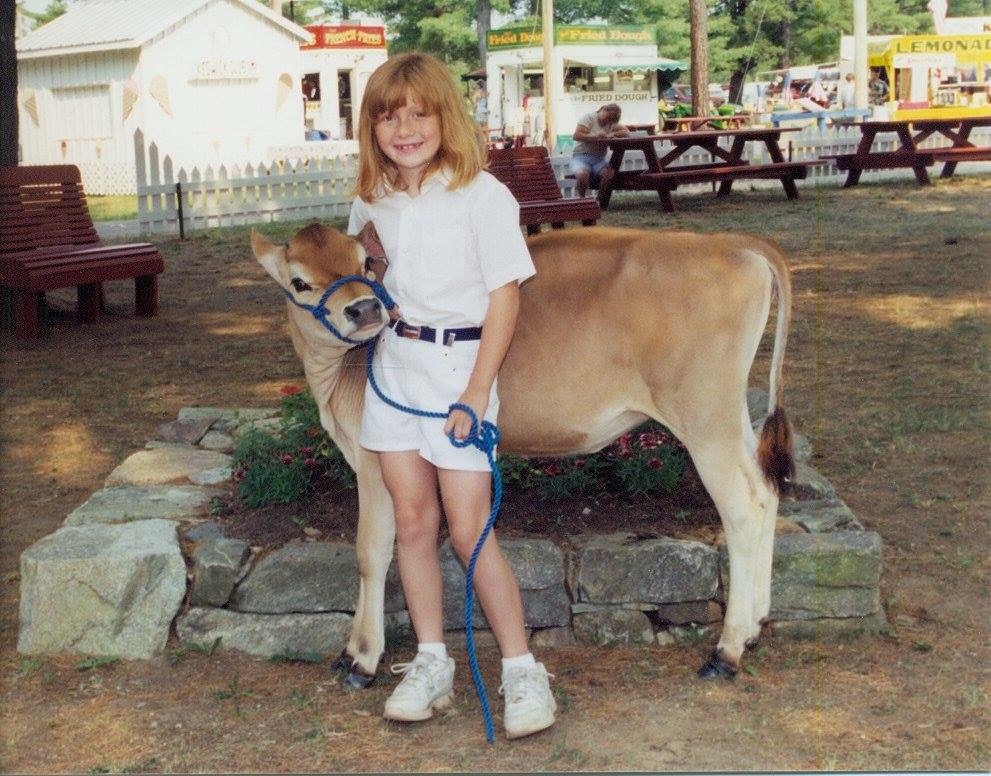
Brittany owned her first cow — a Holstein named Rita — at just 4 years old. Today, Rita’s great-great-great-great granddaughter, Rigatoni, carries on that line.
Finding Her Path in Agricultural Education
A career in ag education wasn’t part of the original plan. She headed to college to study Animal Science, with no particular destination in mind. But when she came home after her freshman year, a connection through a Pineland employee changed everything.
“With my background and livestock experience, I filled a role they were looking for,” she recalls. “I started work that summer, fell in love with the job, and have been sticking around ever since.”
She has been part of the Pineland Farms team since June of 2013, beginning as a seasonal worker while finishing college and transitioning to a year-round position shortly after graduating.
As it turned out, she had been preparing for this role her whole life without knowing it. From ages 5 to 19, she was deeply involved in the Cumberland County 4-H program — a third-generation participant on both sides of her family — exhibiting dairy cattle, swine, and sheep at fairs across Maine.
“I spent many hours over my childhood at Maine’s agricultural fairs talking to the public and answering questions about my animals and agriculture,” she says. “Turns out that was the best training I could have gotten for my role at Pineland.”
Life in the Education Department
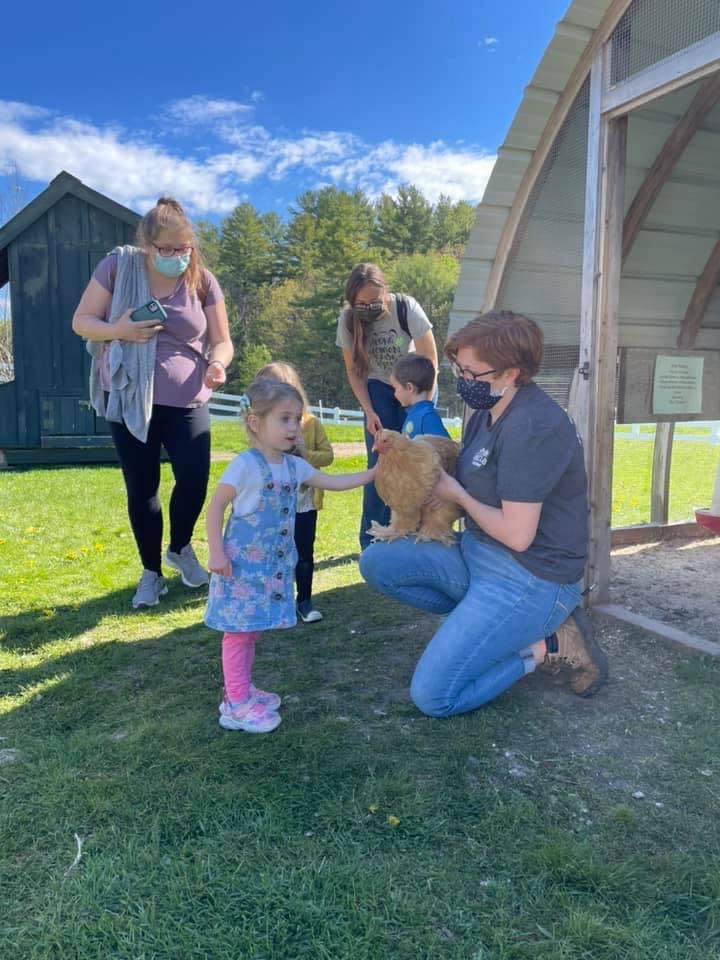
No two days look the same in her role as Assistant Director of the Education Department. Her responsibilities span everything from morning animal chores to teaching programs, scheduling field trips, training new staff, developing curriculum, and procuring new animals for the farm.
“One of my favorite things about my work is that there is rarely a typical day,” she says. “As is the nature of working with animals or children, they are oftentimes unpredictable.”
As she has moved up through the department, her days involve more administrative work than they once did — but she makes sure to stay close to the animals and the teaching that drew her to the job in the first place.
When it comes to her favorite subject matter, the answer is straightforward.
“I will talk about anything that we offer, but my favorite thing will always be the cows,” she says. “I could talk about cows for hours and hours. Often I have to physically hold myself back from dumping all of my favorite cow facts on farm visitors after they have asked me only one question.”
Outside of cattle, she has grown a deep appreciation for Pineland’s nature-based programming. Every spring, she eagerly awaits the return of the Frogs, Fish, & Wiggles programs.
“I wait impatiently for our Frogs, Fish, & Wiggles programs to begin so I can help kiddos catch frogs at the Big Pond!”
June Is Dairy Month — and That Means Something
For Brittany, June’s recognition as Maine Dairy Month carries both personal and professional significance.
“Personally, Dairy Month is a celebration of the community I was raised in and am proud to be a part of,” she says. “It means family and tradition that spans decades.”
She sees it as a moment to shine a light on the hard work of dairy farmers who often go unrecognized.
“Farming can be a thankless job, and Dairy Month provides a time to highlight the hard working, dedicated individuals and families who put in the time to provide food for their communities.”
Professionally, she uses the month to share positive stories from the dairy industry and help visitors better understand the care and commitment that goes into dairy farming.
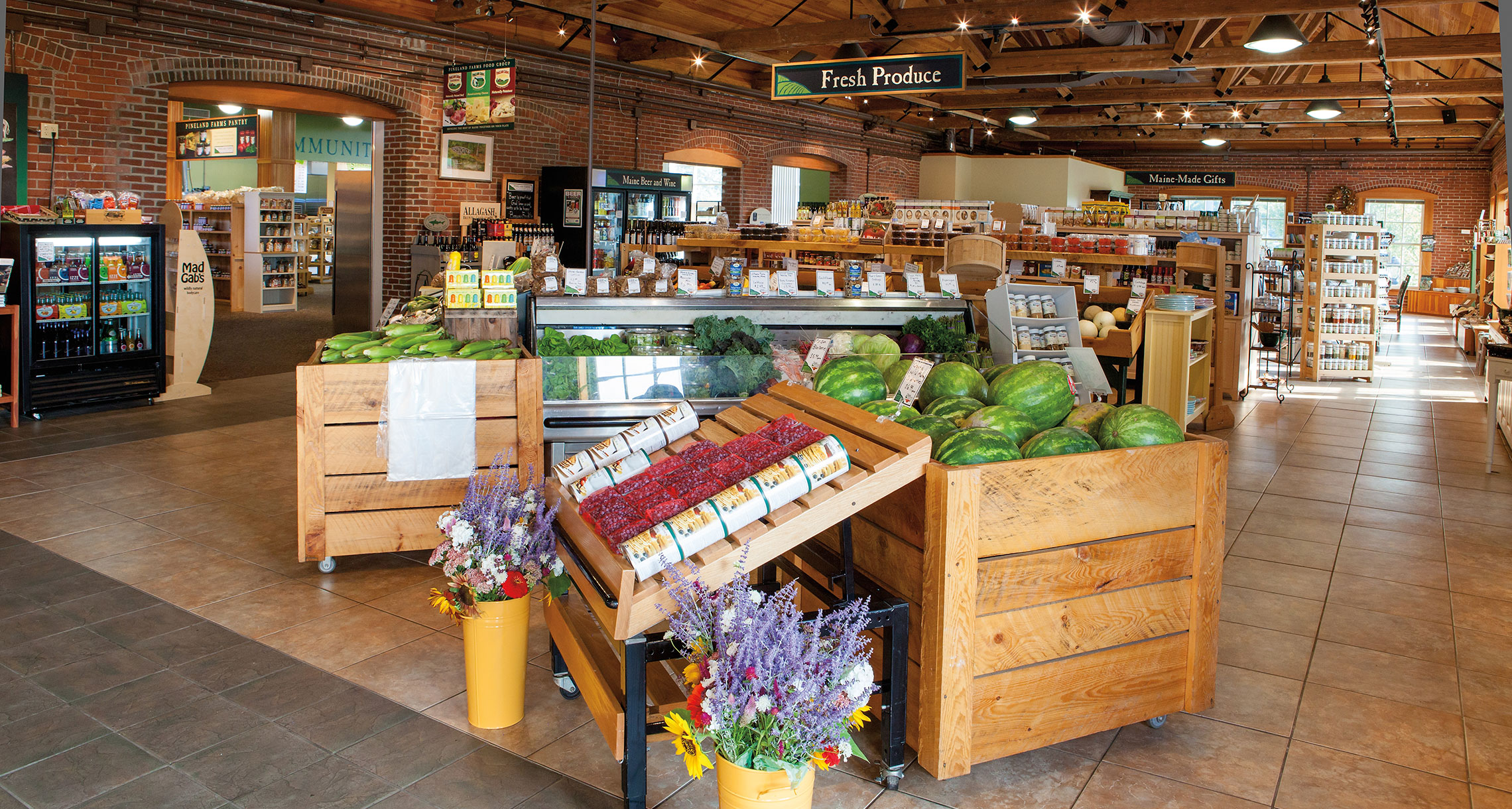
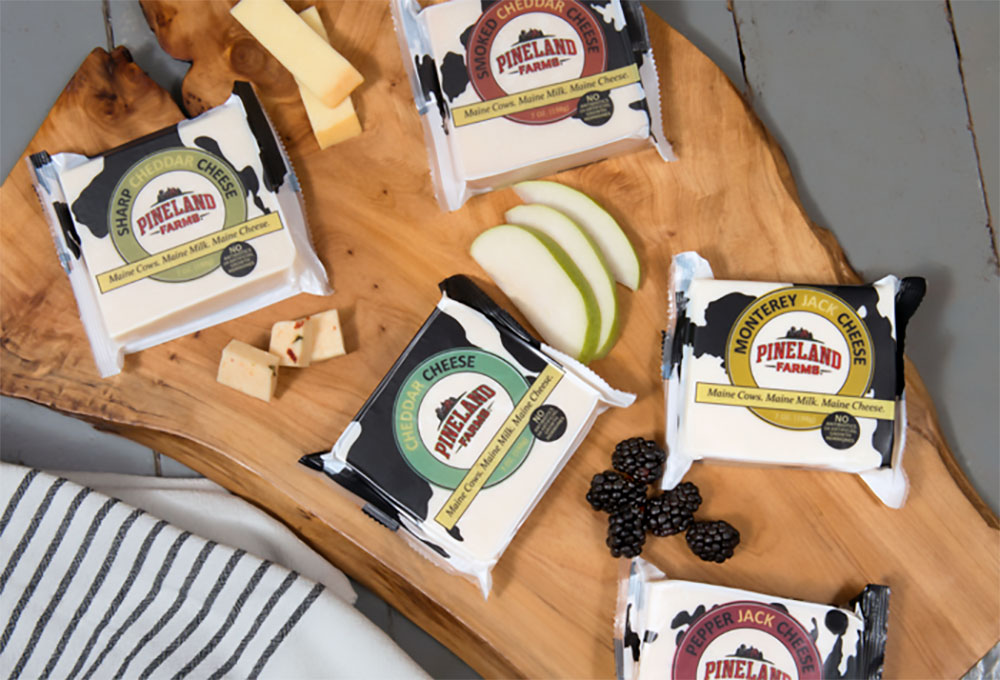
Visitors this June can celebrate Dairy Month by joining one of Pineland’s Ice Cream Making family programs, which are kicking off for the summer season. Participants get to make their own vanilla ice cream while meeting Timber and Thunder, Pineland’s Holstein heifers. And of course, a stop at the Market & Welcome Center for some Pineland cheese is always a good idea.
“My personal favorites are the Vintage Aged Cheddar Cheese or the plain Cheese Curds,” she admits. “I am guilty of making many end of the workday visits to the Market for some Vintage Cheddar and nibbling on it like a mouse on my drive home.”
Meet Timber, Thunder, and the Herd
Timber and Thunder — Pineland’s two Holstein heifers — hold a special place in the farm’s story. When the dairy farm closed, they were the youngest calves on the property, and the decision was made to keep them as dairy cattle ambassadors.
“It felt right to keep those two specifically, as they are direct descendants of the Holstein herd that was purchased from Mike Wilson, or Wilsondale Farm, to start the Pineland dairy farm,” she explains.
At just over a year old, the pair are, as she puts it, “basically teenagers right now.” They’ll be considered adults when they turn two in January 2027, and the hope is that they’ll have their first calves soon after, at which point they’ll begin producing milk.
Holsteins are the most widely kept dairy breed in the country, making up roughly 90% of dairy cattle in the United States. Their milk production capacity is remarkable — a single Holstein cow can average 80 to 100 pounds of milk per day, or 24,000 to 30,000 pounds over a 300-day lactation. Over a lifetime of four to six lactations, a cow’s total production can reach between 140,000 and 180,000 pounds of milk.
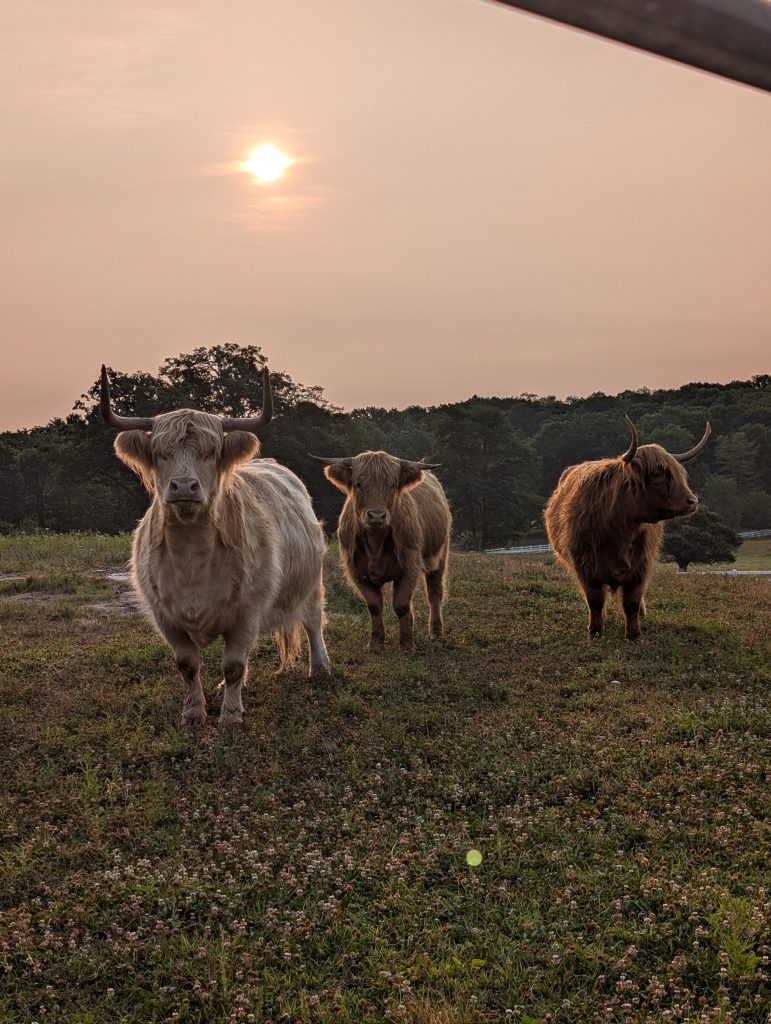
Pineland is also home to three Scottish Highland cattle — Stanleigh, Rona, and Norma — who offer a striking contrast to the tall, lean Holsteins. Hardy, stout, and covered in long shaggy coats, the Highlands are a beef breed well-suited to Maine’s climate. They spend the warmer months grazing their pasture with minimal intervention, and move to a sheltered winter pasture with hay access when the grass disappears.
The Animals Have Personalities — and She’ll Tell You All About Them
One of the most common misconceptions Brittany encounters is the belief that cows simply produce milk all the time, continuously.
“I answer that question pretty frequently, even to this day,” she says with a laugh. In reality, dairy cows must give birth in order to produce milk and follow a roughly 300-day milking cycle, followed by a dry period for rest and recovery.
Another surprise for many visitors is just how personable farm animals can be.
“They are livestock and they have a job to do on the farm, but they truly do each have their own personalities and quirks.”
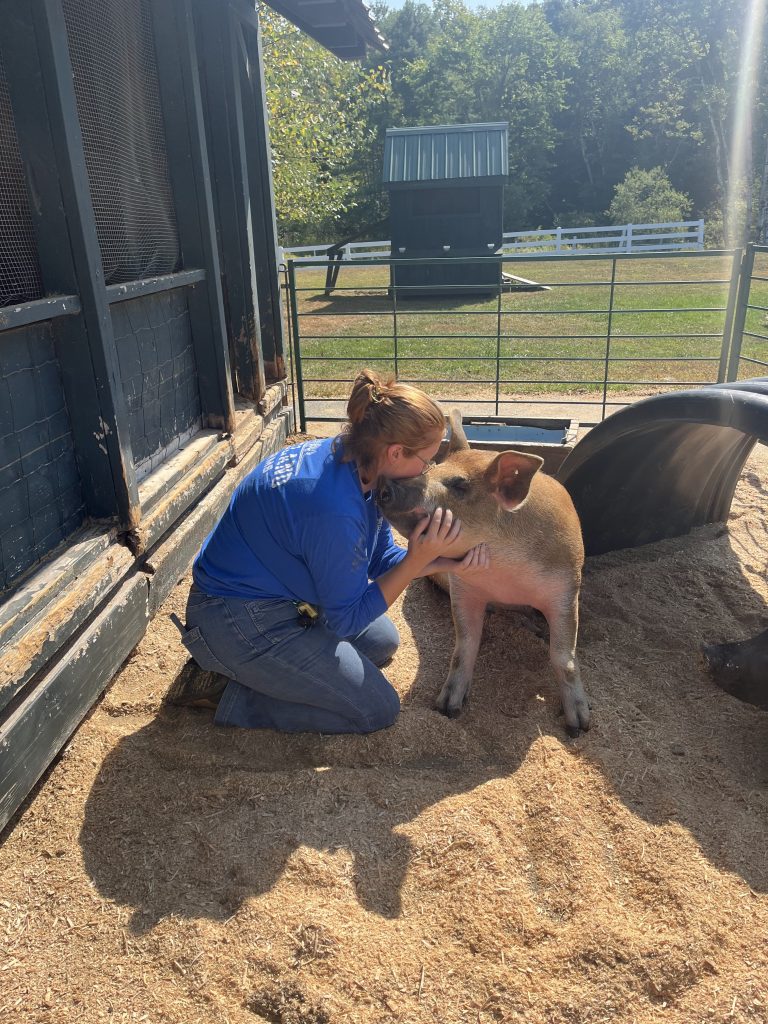
Her favorites on the farm extend beyond cattle. She grew up raising pigs and holds a soft spot for Pineland’s seasonal swine arrivals every summer.
“They have the best temperaments and are always up for a belly rub. I particularly love sharing them with our farm visitors because they can appear large and scary but have dispositions like a big friendly dog.”
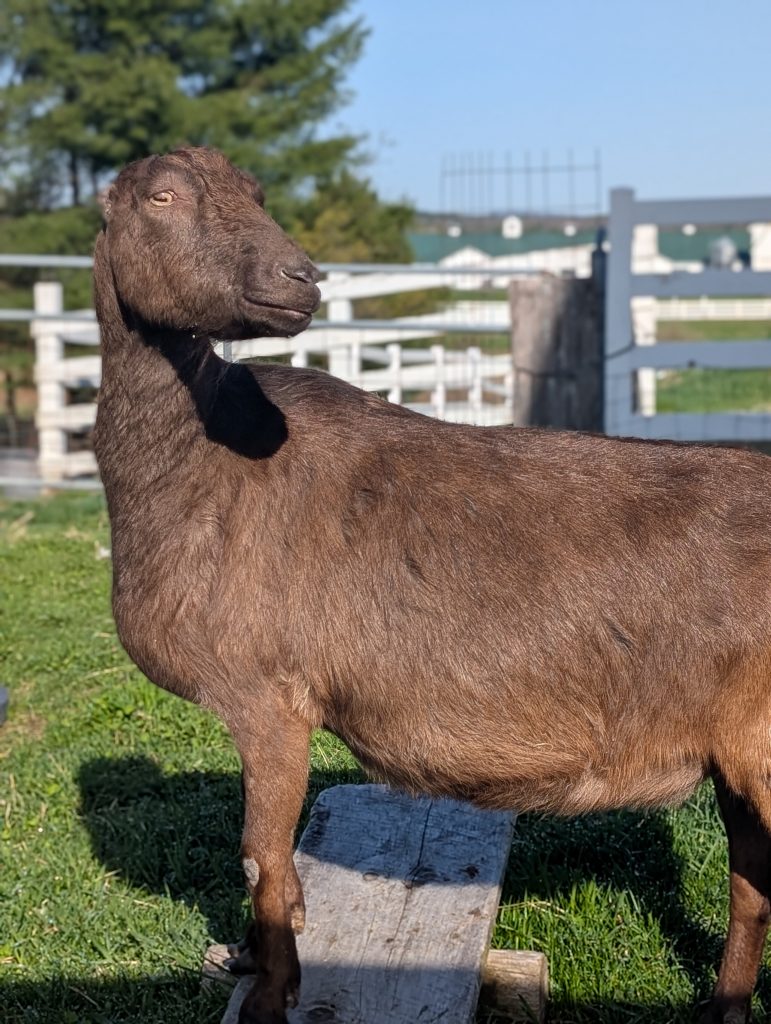
She also has a long-standing favorite in the goat pen: a seven-year-old LaMancha goat named Tansy, who arrived at Pineland when she was just three months old.
“I refer to her as our Herd Queen in the goat pen. She is large and in charge and every other goat knows it,” she says. “She does have a sweet side though and is almost always the goat that greets you first when you open up the gate. Her and I have shared many a moment together on cold, rainy days when I needed a goat-shaped space heater and she needed a good chin scratch.”
Women in Agriculture
For Brittany, being a woman in agriculture and agricultural education means something larger than her own story.
“To me, it means showing girls and young women that farming and agriculture is accessible to all,” she says. “I was incredibly fortunate to have some amazing women in the farming community to look up to when I was growing up, and it is very important to me to pass that on to the next generations.”
Her advice to young women — or anyone — drawn to agriculture is expansive and inclusive.
“There are a million ways to be involved in agriculture or working with animals. There is no one ‘right’ way. The person milking cows every day is important, but so are the people marketing dairy products, running payroll, educating the public, analyzing feed samples, or innovating new technology.”
“If your passion is agriculture, figure out your strengths and how YOU want to be involved in the industry. Don’t let anyone tell you there isn’t a place for you just because you don’t fit the ‘farmer’ vision they have.”
Why Farm Connection Matters
Brittany believes that understanding where our food comes from — and everything else agriculture provides — is more important than ever.
“So much of the general public is now so far removed from farms and agriculture that they often don’t really know how much it may be a part of their everyday lives,” she says.
She likes to remind visitors that agriculture touches far more than food. Cotton in clothing and shoes, wood pulp in paper towels and cardboard, glycerin from plant and animal fats in soaps and lotions, lanolin from sheep’s wool in Vitamin D supplements, leather in footballs and baseballs — the list goes on.
Her goal for every visitor is simple: leave with something new.
“I hope our farm visitors leave Pineland with a fun story, a goofy animal photo, and one new factoid they didn’t know when they arrived,” she says. “You don’t need to learn everything there is to know about sheep and wool to take home an appreciation for the animals and the people taking care of them. One bit of information at a time, mixed with some laughs or just a sunny day spent outside, helps us move in the right direction.”
A Lasting Impact
When asked about her favorite memory from her years at Pineland, Brittany doesn’t settle on a single moment. What stands out most, she says, are the people.
“One of the most rewarding parts of this job has been getting to know our seasonal farm educators, who all arrive with different backgrounds, experiences, and perspectives that shape the work we do together,” she reflects. “I trained them on what they needed for the job, but the truth is I learned just as much from them in return.”
Many of those seasonal educators have moved on, but the connections haven’t faded.
“Even though many are only here for a season, each person leaves a lasting impact on both the Education Department and the full-time staff. Many have moved on from Pineland, but the connections we built didn’t end when their season did — many of them have become close friends of mine.”
What keeps her coming back, season after season, is the same thing that has driven her since she first walked onto the farm more than a decade ago.
“It will never stop being important,” she says. “Our food, our clothing, so many of our daily amenities originated in nature or on a farm, and to preserve that we need to understand it and pass it on. I was fortunate to have great teachers, both in and out of the classroom, who passed their knowledge and passion on to me — and it fills me with great joy to do the same.”
*Interested in experiencing dairy at Pineland Farms this summer? Join us for an Ice Cream Making family program June through September, or stop by the Market & Welcome Center to pick up some of our handcrafted Pineland cheeses. We’ll see you on the farm!*